


Hammer

Lightweight aluminum formwork is a specialized subcategory within the broader family of aluminum formwork systems, designed and developed specifically to reduce weight, enhance construction efficiency, and adapt to specific construction conditions. These templates inherit the general advantages of aluminum formwork systems while significantly reducing the weight of individual panels through material optimization, structural design innovations, and production processes. Here is a detailed introduction to lightweight aluminum formwork products:
- Weight Reduction: Lightweight aluminum formwork weighs significantly less than regular aluminum formwork (typically around 30 kg/m²), with some models even dropping below 20 kg/m², greatly reducing manual handling burdens, accelerating on-site construction efficiency, and being particularly suitable for high-rise buildings, confined spaces, or sites without large machinery assistance.
- Ease of Installation: The lightweight nature of these templates makes individual panels easier to handle and install, requiring less effort and resulting in faster assembly and disassembly times, reducing labor costs and overall construction duration.
- Adaptability: For special structures (such as irregular walls, curved buildings, or complex nodes) or projects with strict weight limitations (e.g., building renovations, bridge construction, temporary supports), lightweight aluminum formwork offers superior adaptability due to its low weight and high flexibility, better fulfilling design requirements and site-specific conditions.
- Energy Efficiency and Sustainability: In addition to reducing transportation energy consumption, lightweight aluminum formwork also decreases the labor and resources needed during construction, contributing to lower carbon emissions and improved energy efficiency.
Material Selection: Employ lighter aluminum alloys containing elements such as magnesium or manganese, or optimize alloy compositions and heat treatment processes to increase material strength and rigidity while maintaining sufficient load-bearing capacity despite weight reduction.
Structural Optimization: Utilize thin-wall designs, hollow structures, and strategically placed reinforcement ribs to distribute materials efficiently, minimizing weight while ensuring overall stability and stiffness of the formwork. Some areas may incorporate composite materials or lightweight fillers to further reduce weight.
Connection Improvements: Develop more compact and lightweight connection components and fastening systems, such as self-locking connectors, pre-embedded bolts, or magnetic fixing devices, simplifying template assembly and reducing additional weight.
Modularity and Standardization: Implement highly modular designs, increasing versatility and reducing the number of non-standard parts, enabling rapid on-site assembly and flexible adjustments. Simultaneously, maintain precision inter-panel fit through standardized production processes and dimensions, ensuring high construction accuracy.
Aluminum mold construction hook and hammer are common special tools used in the construction process of aluminum formwork, they are specially designed for the characteristics of aluminum formwork and construction needs, aiming to improve work efficiency, protect aluminum formwork from damage, and ensure the wall quality and construction safety after concrete pouring.
Aluminum mold construction hammer is customized for the characteristics of aluminum template construction tools, mainly used in the template installation of percussion positioning, fastener drive, template minor correction and other work.
Specific applications include: Template tapping positioning: When installing a template, gently tap the template with a hammer to make it closely fit with the embedded parts, support brackets, or adjacent templates to ensure the stability of the template system.
Fastener driving: When connecting the formwork or fixing the formwork with the support structure, use a hammer with a rubber or plastic pad to hit fasteners such as special bolts and pins to avoid damage caused by directly hitting the aluminum formwork.
Template fine-tuning: For minor template deformation or position deviation, you can use a hammer with an appropriate tool (such as a wooden wedge) to fine-tune and restore the correct position of the template.

Examining Report
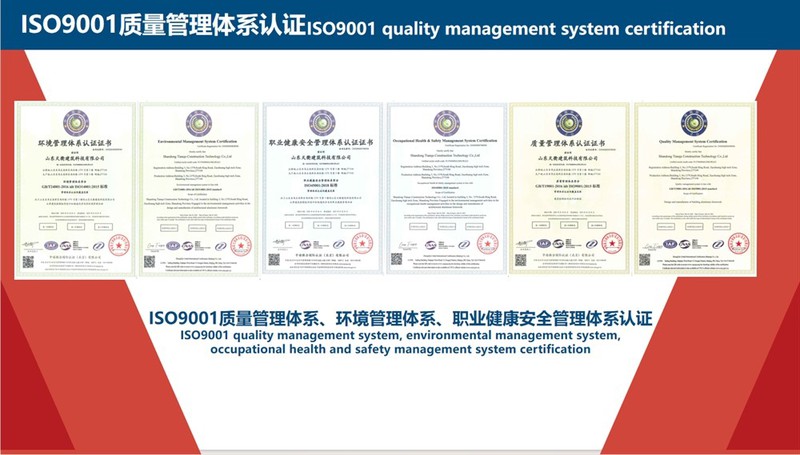
ISO certification: The workshop follows the ISO 9001 quality management system standard to ensure the whole process quality control from raw material procurement, production process to finished product inspection.
Strict process inspection: set up multi-process inspection points, real-time monitoring of profile processing, template assembly, connector installation and other links, timely detection and correction of quality problems.
Quality traceability system: The use of information means to establish product quality traceability system, to ensure that each batch, each piece of template can be traced to the specific production batch, raw material source, operator and other information, to facilitate quality problem investigation and responsibility traceability.
Regular internal audit and external third-party testing: Conduct regular internal quality management system audit, and invite third-party authoritative testing institutions to conduct random product inspections to ensure that product quality continues to meet national and industry standards.

Honorary Association Membership
As an honorary member of both frame Structure Aluminium Wall Panel industry associations and building technology societies, we take great pride in this distinction. Such recognition not only validates our outstanding contributions in areas like technological innovation, industry standard formulation, market development, and environmental sustainability, but also underscores our preeminent position within the industry. As an honored member, we have the privilege of participating in various high-level forums, seminars, and technical exchanges, staying closely connected with the elite of the global frame Structure Aluminium Wall Panel supply chain, keeping abreast of industry frontiers, and enhancing our innovation capabilities. This membership also furnishes us with a broad platform for industry collaboration, enabling us to engage in deep strategic partnerships with enterprises worldwide, jointly driving the advancement of frame Structure Aluminium Wall Panel technology and market expansion.

Strategic Partners with Tianqu Aluminum Formwork
We are honored to have cultivated enduring, dependable partnerships with a broad spectrum of global associates encompassing real estate developers, general contracting firms, design establishments, and rental entities. Our extensive reach spans Asia, Europe, and the Americas, testifying to both our strong brand presence and adeptness in expanding our business footprint internationally. This extensive network signifies that our aluminum formwork offerings and solutions effectively address the varied requirements of different geographies, climates, and architectural idioms. Notably, we have formed strategic alliances with industry leaders, engaging in joint product development, market promotion, and resource sharing endeavors. These collaborations exemplify our aptitude for resource optimization and collaborative innovation within the realm of aluminum formwork technology.

Hot Tags: hammer, China hammer manufacturers, suppliers, factory


