

2025 Aluminum Ingot Price Review and Market Outlook | Practical Guide for Aluminum Formwork Manufacturers on Raw Materials and Scrap Management
In 2025, aluminum ingot prices staged a remarkable comeback-transitioning from early-year volatility and sluggishness to accelerated growth in the second half. By year-end, prices surpassed 22,000 yuan per ton, hitting a three-year high. This significant upward shift in the annual price benchmark profoundly impacted the entire aluminum industry chain. As practitioners in the aluminum alloy formwork leasing industry, we understand that raw material procurement and scrap disposal costs for aluminum formwork manufacturers directly impact leasing pricing, profit margins, and market competitiveness. This article comprehensively reviews the trajectory of aluminum ingot prices in 2025, deeply analyzes the core logic behind price fluctuations, and combines current political, economic, and industrial policies to forecast future price trends. It also provides actionable recommendations for aluminum formwork manufacturers on raw material procurement and scrap disposal, helping industry peers mitigate risks and seize opportunities.
I. Comprehensive Review of 2025 Aluminum Ingot Price Trends: The Resurgence Curve from Slump to Surge The 2025 aluminum ingot price exhibited distinct characteristics: "volatile consolidation in the first half, followed by a unilateral upward trend in the second half." The annual trajectory can be divided into three clear phases. Based on Shanghai aluminum futures and spot A00 aluminum price data, the detailed review is as follows, balancing industry universality with practical reference for aluminum formwork raw material procurement:
(1) Phase One: January–April – Volatile Lows and Bottom Consolidation
At year's start, SHFE aluminum futures hovered near ¥19,700/ton, with spot A00 aluminum prices similarly stagnating at low levels. Entering April, influenced by short-term supply-demand imbalances and cautious market sentiment, aluminum ingot prices further declined to the annual low of ¥19,000/ton. During this period, raw material procurement pressure for aluminum mold manufacturers was relatively low. Most factories maintained an on-demand procurement and low-inventory operation model. Scrap disposal prices also remained depressed alongside the sluggish aluminum ingot market, keeping overall industry profit margins relatively stable.
(2) Second Phase: May-August, Volatile Recovery and Gradual Improvement Starting in May, aluminum ingot prices began a slow recovery, with monthly gains gradually expanding. By the end of August, spot aluminum prices rebounded to around RMB 20,500/ton, marking a 7.9% increase from April's low. During this phase, price recovery remained moderate without significant volatility. Aluminum mold manufacturers largely adopted a "replenish inventory as needed while maintaining cautious observation" approach, keeping raw material procurement rhythms relatively stable. Scrap disposal prices also saw a modest, synchronized uptick alongside aluminum prices.
(3) Third Phase: September-December, Accelerated Uptrend and Record Highs Entering the second half of the year, particularly after September, aluminum ingot prices entered an accelerated upward trajectory with significantly widening gains. On December 7-8, prices decisively breached the RMB 22,000/ton threshold, setting a new record high since 2022. By December 31, the main Shanghai aluminum futures contract closed at 22,925 yuan/ton, with an annual average price of 20,700 yuan/ton-a 4% year-on-year increase compared to 2024. During this period, the rapid surge in aluminum ingot prices directly inflated raw material procurement costs for aluminum formwork manufacturers, while scrap disposal prices also skyrocketed. Some manufacturers faced short-term profitability pressures due to insufficient raw material inventories and soaring procurement costs, which indirectly impacted pricing strategies for aluminum alloy formwork rentals.
II. Core Drivers of Aluminum Ingot Price Fluctuations in 2025 (Political + Economic + Industrial Dimensions) The 2025 aluminum ingot price rebound was not coincidental but resulted from the convergence of multiple factors: global macroeconomics, domestic industrial policies, industry supply-demand dynamics, and energy market dynamics. Several of these factors directly impact the long-term development of the aluminum formwork industry, as detailed below:
(I) Core Upside Drivers (Dominating Second-Half Market, Most Impactful for Aluminum Formwork Manufacturers) 1. Industrial Policy: Carbon Trading Implementation Tightens Supply Rigorously. In March 2025, the aluminum smelting sector was formally incorporated into the national carbon emissions trading market, marking a new phase of green transformation for this energy-intensive industry. Industry estimates indicate that initial carbon pricing levels will increase aluminum production costs by several hundred yuan per ton. These costs will ultimately be passed downstream, driving up the central price of aluminum ingots. Simultaneously, China's 45 million metric ton capacity cap for primary aluminum imposes rigid constraints, limiting new capacity additions. By 2025, domestic primary aluminum output reached 43.1068 million metric tons, with a capacity utilization rate of 95.7%. Net expansion capacity fell below 540,000 metric tons. This supply-side contraction became the core driver for aluminum price increases and directly undermined the stability of aluminum formwork raw material supply. 2. Supply-Demand Dynamics: Supply-demand mismatch intensifies, with inventory depletion persisting. The demand side exhibits robust "transition from old to new growth drivers." On one hand, aluminum applications in green building sectors continue to expand. As a core component of green construction, aluminum alloy formwork maintains steady demand growth. On the other hand, explosive growth in new energy vehicles and the photovoltaic industry has significantly boosted aluminum demand-each GW of PV installation consumes 19,000 tons of aluminum. By 2025, global PV capacity additions will drive substantial aluminum demand, while new energy vehicles require twice the aluminum per unit compared to traditional models, further diverting raw material supplies from the aluminum formwork sector. On the supply side, seasonal fluctuations in hydropower generation in regions like Yunnan and Sichuan, which are rich in hydroelectric resources, have periodically constrained local aluminum plant production. This has further tightened supply, driving aluminum inventories to persistently deplete to historic lows. The supply-demand mismatch became the direct catalyst for the sharp surge in aluminum prices in the second half of the year. 3. Energy Costs: Intensified electricity competition elevates cost curves. Electrolytic aluminum is a classic "power-hungry" industry, with electricity costs accounting for 30%-50% of per-ton production expenses. By 2025, explosive growth in electricity demand for AI data center construction creates direct competition with aluminum producers for power. Structural increases in industrial electricity prices across multiple provinces have directly inflated electrolytic aluminum production costs, ultimately impacting aluminum ingot prices. Additionally, Europe's ongoing energy crisis and high electricity prices are constraining overseas aluminum plant restarts, further tightening global aluminum supply. Strengthened price linkage between domestic and international markets reinforces the upward trend in domestic aluminum prices. 4. Macroeconomic Factors: Global Inflation Expectations + Loose USD Liquidity. In the second half of 2025, renewed global inflation expectations coupled with loosening USD liquidity brought the financial attributes of non-ferrous metals back into focus. As a commodity possessing both industrial and financial characteristics, aluminum attracted substantial institutional capital allocation, further amplifying price increases. Concurrently, China's sustained "stabilize growth and promote infrastructure" policies drove increased investment in green building and new infrastructure sectors. This indirectly boosted demand for aluminum formwork, thereby supporting upward momentum in aluminum ingot prices.
(II) Reasons for First-Half Slump (Short-Term Factors, Now Resolved) 1. Seasonal Demand Slump: The first half traditionally marks a slow season for downstream industries like construction and new energy. Procurement demand for aluminum alloy formwork remained relatively weak, with manufacturers showing limited willingness to source raw materials. Insufficient demand-side support prevented aluminum ingot prices from rebounding. 2. Declining Alumina Prices: Overseas bauxite mines significantly resumed and expanded production in 2025, causing rapid growth in alumina supply and substantial price drops. The average alumina price in 2025 was 3,237 yuan/ton, down 21% year-on-year. This partially offset cost pressures on primary aluminum and dampened upward momentum for aluminum ingot prices. 3. Market Sentiment: At the beginning of the year, the market underestimated the impact of carbon trading policies and power supply constraints. Combined with cautious expectations for global economic recovery, market sentiment remained conservative, and capital allocation willingness was low. This resulted in aluminum ingot prices remaining in a prolonged state of fluctuating weakness.
III. Forecast for Future Aluminum Ingot Price Trends (Aligned with Current Political Economy and Aluminum Mold Industry) Considering the current (February 2026) political-economic environment, industrial policies, and supply-demand dynamics, and synthesizing analyses from multiple institutions, aluminum ingot prices are projected to follow an overall trend of "short-term high-level consolidation with corrections, and long-term upward shift in the central price level." While a unilateral surge like that seen in the latter half of 2025 is unlikely, prices are expected to remain elevated over the long term. The specific forecast aligns with aluminum formwork manufacturers' raw material procurement planning:
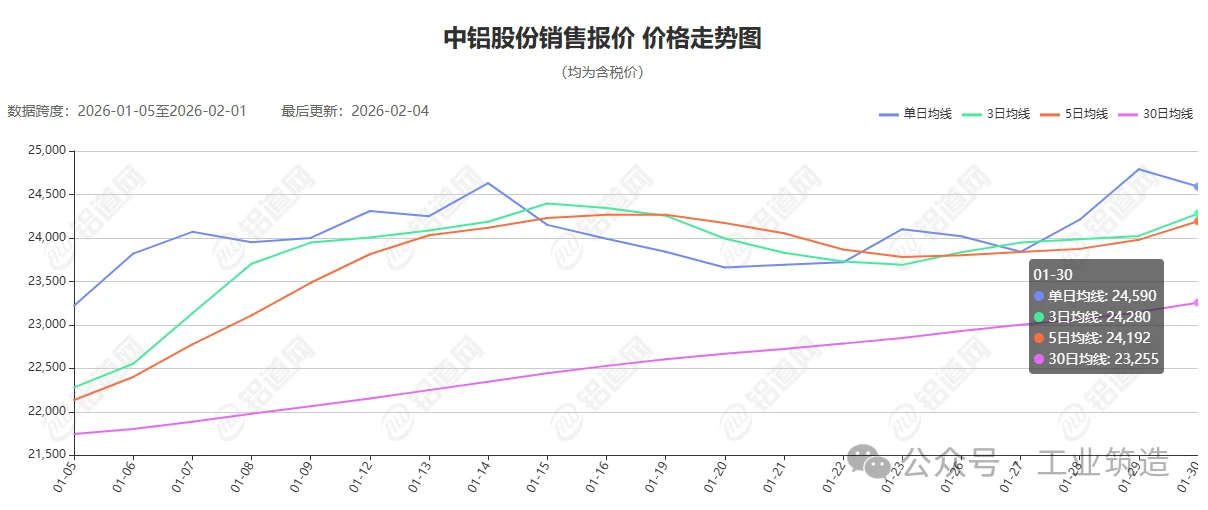
(I) Short Term (February-June 2026): High-level fluctuations with potential for correction 1. Core Logic: Aluminum ingot prices began 2026 extending the upward momentum from late 2025, with spot A00 aluminum surpassing 24,000 yuan/ton-just 90 yuan/ton below the 2021 historical peak. However, prices are now in an elevated range, indicating imminent short-term correction pressure. On one hand, downstream industries gradually resume operations after the Spring Festival, releasing pent-up aluminum demand. Yet the earlier price surge has already preempted part of this demand. On the other hand, regulators may introduce policies to regulate commodity prices, curb excessive speculation, and alleviate upward price pressure. 2. Price Range: Spot A00 aluminum prices are projected to fluctuate within the 22,000-24,000 yuan/ton range. Support for a pullback is around 22,000 yuan/ton, with limited downside potential (as supply-side growth remains negligible). This phase presents a relatively reasonable window for aluminum mold manufacturers to replenish inventories.
(II) Medium-to-Long Term (Second Half of 2026–2027): Center of Gravity Shifts Upward, Maintaining Elevated Levels 1. Core Support Factors: (1) Supply Side: China's rigid electrolytic aluminum capacity cap persists, limiting new production additions; Overseas supply uncertainties intensify: Mozal Aluminium (South Africa, 580,000 tons/year capacity) will shut down in March 2026; Century Aluminium (Iceland) reduces output by two-thirds; European capacity faces shutdowns due to high electricity prices and environmental regulations. Overseas capacity exits may exceed 1 million tons in 2026, with global supply growth limited to 1%-2%. The tight supply-demand balance will persist long-term. (2) Cost Side: Carbon trading costs will continue to be internalized. The EU's Carbon Border Adjustment Mechanism (CBAM) will be implemented for the aluminum industry in 2026, with no free allowances starting in 2034. The tax burden may exceed €125/ton. Domestically, the green electricity transition continues to advance, making it difficult for primary aluminum production costs to decrease significantly. Meanwhile, the power shortage situation is unlikely to ease in the short term, and competition for electricity between AI and primary aluminum production will persist long-term, supporting an upward shift in aluminum price fundamentals. (3) Demand Side: Aluminum demand will grow steadily in sectors like green buildings, new energy vehicles, and photovoltaics. As a core product enabling lightweight and green construction, aluminum alloy formwork is expected to maintain stable demand growth, providing long-term support for aluminum ingot prices. Furthermore, the "aluminum replacing copper" trend is accelerating, with expanding applications in air conditioning and electrical cables further broadening aluminum's demand prospects. (4) Macroeconomic and Geopolitical Factors: Expectations for the Fed to cut interest rates in 2026 are rising, with a weaker dollar benefiting commodities. Domestically, the launch of the 15th Five-Year Plan, coupled with proactive policies and scrap-for-new initiatives, will boost market confidence. Meanwhile, geopolitical tensions between the U.S. and Venezuela are disrupting bauxite supply. Combined with anticipated increases in U.S. steel and aluminum tariffs, companies preemptively locking in supplies will further tighten the spot market and amplify price volatility. 2. Price Range: Projected 2026 average aluminum ingot price around RMB 23,000/ton. Medium-to-long term (2026-2027) prices will remain elevated at RMB 22,000-25,000/ton, further exceeding 2025 averages. Aluminum mold manufacturers must prepare for sustained high raw material costs.