

What is the service life of a rural villa constructed using aluminium formwork and cast-in-place frame-shear wall structures?
In truth, theoretical lifespan and actual lifespan are distinct concepts. We may analyse this in detail from the following perspectives:
I. Theoretical Design Lifespan (Statutory Minimum Standard)
According to China's current Unified Standard for Reliability Design of Building Structures (GB 50068), the design service life for ordinary buildings and structures is 50 years. This denotes the period during which the structure can fulfil its intended purpose without major repairs, provided it undergoes proper design, construction, usage, and maintenance.
Important Note: The '50-year' benchmark represents the statutory minimum safety usage standard. It does not imply the building will collapse or become unusable after 50 years. Rather, it functions as a 'warranty period' commitment, guaranteeing the structure's safety and functionality within this timeframe.
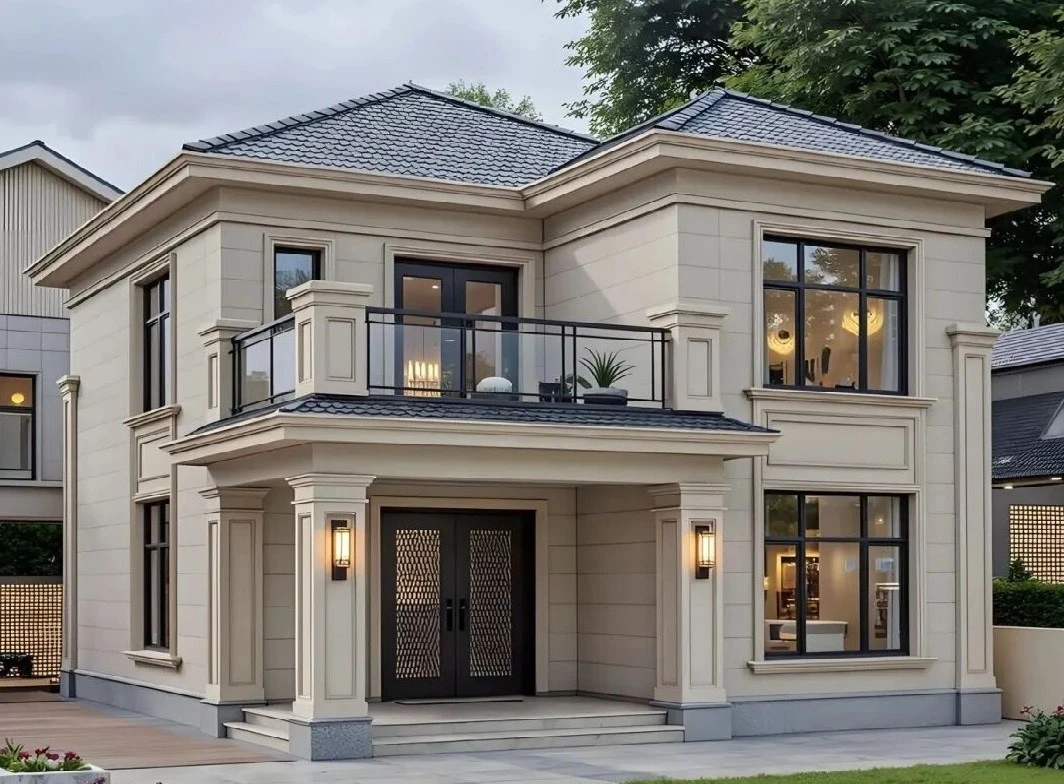
II. Advantages of Aluminium Formwork Cast-in-Place Shear Wall Structures
The combination you have selected represents a highly advanced and reliable solution for contemporary rural self-build homes, whose inherent characteristics contribute to an actual service life far exceeding 50 years:
1. Advantages of Aluminium Formwork:
High-quality formwork finish: After concrete pouring, the surface is exceptionally flat and smooth, with minimal leakage or formwork expansion, ensuring precise structural dimensions.
2. High Density: When combined with proper vibration, it produces exceptionally dense concrete, significantly enhancing strength, waterproofing, and resistance to carbonation. Improved carbonation resistance directly protects internal reinforcement, forming the core of extended structural longevity.
3. Superior structural integrity in cast-in-place shear-wall systems: Functioning as a cohesive 'stone box', it delivers far superior seismic and wind resistance compared to brick-concrete or frame structures.
4. High load-bearing capacity: Walls serve as load-bearing elements, enabling flexible spatial layouts and enduring durability.
III. Key Factors Determining Actual Lifespan
Note: The service life of a villa (achieving 70-100 years or longer) primarily depends on the following factors, which are more critical than the structural form alone:
1. Design and Construction Quality:
Structural Design: Are formal design drawings available? Are load calculations, reinforcement ratios, and joint detailing appropriate? Are ground investigations and foundation designs robust?
2. Material Quality:
Does the cement grade, reinforcing steel brand and specification, and aggregate quality meet standards? Is the concrete mix design scientifically formulated? Are construction techniques, reinforcement works, and steel tying compliant with regulations?
Concrete Works: Was pouring continuous? Was compaction thorough? Was curing adequately performed?
3. Natural Environment:
Geological Conditions: Is the foundation uniform and stable? Is the site located in a landslide or subsidence zone?
3. Climatic conditions: Salt spray corrosion in coastal areas and freeze-thaw cycles in northern winters pose additional challenges to concrete and reinforcement, demanding higher standards in construction and materials.
IV. Comprehensive Conclusions and Recommendations
For a rural villa designed strictly to code, constructed using qualified materials by professional teams employing aluminium formwork for cast-in-place shear walls, and maintained appropriately, we can make the following assessments:
1. Structural Service Life: The primary structure (beams, slabs, columns, shear walls) possesses a service life fully capable of exceeding 100 years, reaching 100 years or longer. Numerous high-quality concrete structures built in the mid-20th century remain in service today.
2. Functional lifespan: Factors contributing to a dwelling feeling 'dated' and requiring refurbishment typically involve non-structural issues such as ageing plumbing and electrical systems, outdated interior/exterior finishes, diminished window/door sealing performance, and layouts no longer meeting contemporary needs. These aspects can be updated through subsequent renovations, akin to dressing a sturdy framework in new attire.
Our final recommendations:
1. Based on building codes and practical experience, rural villas constructed with aluminium-formwork cast-in-place shear-wall structures can readily exceed 100 years of service life, with some structures lasting 100-120 years.
2. Select a reputable construction team: Prioritise contractors with extensive aluminium-formwork experience, as their craftsmanship directly determines the final concrete quality.
3. Prioritise curing and waterproofing: Post-pour concrete curing and comprehensive waterproofing throughout the property represent cost-effective longevity measures with significant returns.
4. View longevity rationally: You are constructing not a 'temporary dwelling' but a 'century-spanning family legacy' to be passed down through generations. Investing an additional 10% in structural integrity and construction quality upfront proves far more economical than enduring costly repairs and safety concerns later.
Translated with DeepL.com (free version)