

In the construction industry, there's an old saying: "Construction is 30%, repair is 70%." In the past, we often saw delivered houses with uneven walls, requiring thick layers of plaster to "cover up" the flaws. Inadequate workmanship even led to leaks, hollow spots, and cracks in the exterior walls, becoming a persistent nightmare for homebuyers. However, with the innovation of construction technology, a process hailed as "green gold" in construction-aluminum alloy formwork (aluminum mold) construction-is redefining the standards of a good house.
What is aluminum mold? A "revolution" in the construction industry: Insisting on innovation to improve product competitiveness.
Aluminum mold, or aluminum alloy formwork system, is a brand-new formwork system composed of high-strength aluminum alloy profile panels, support systems, and accessories. If traditional wooden formwork is like "hand tailoring," relying on the skill of workers, resulting in large errors and easy deformation, then aluminum mold is like a "precision machine tool," employing industrialized production, with standardization and modularization at its core.
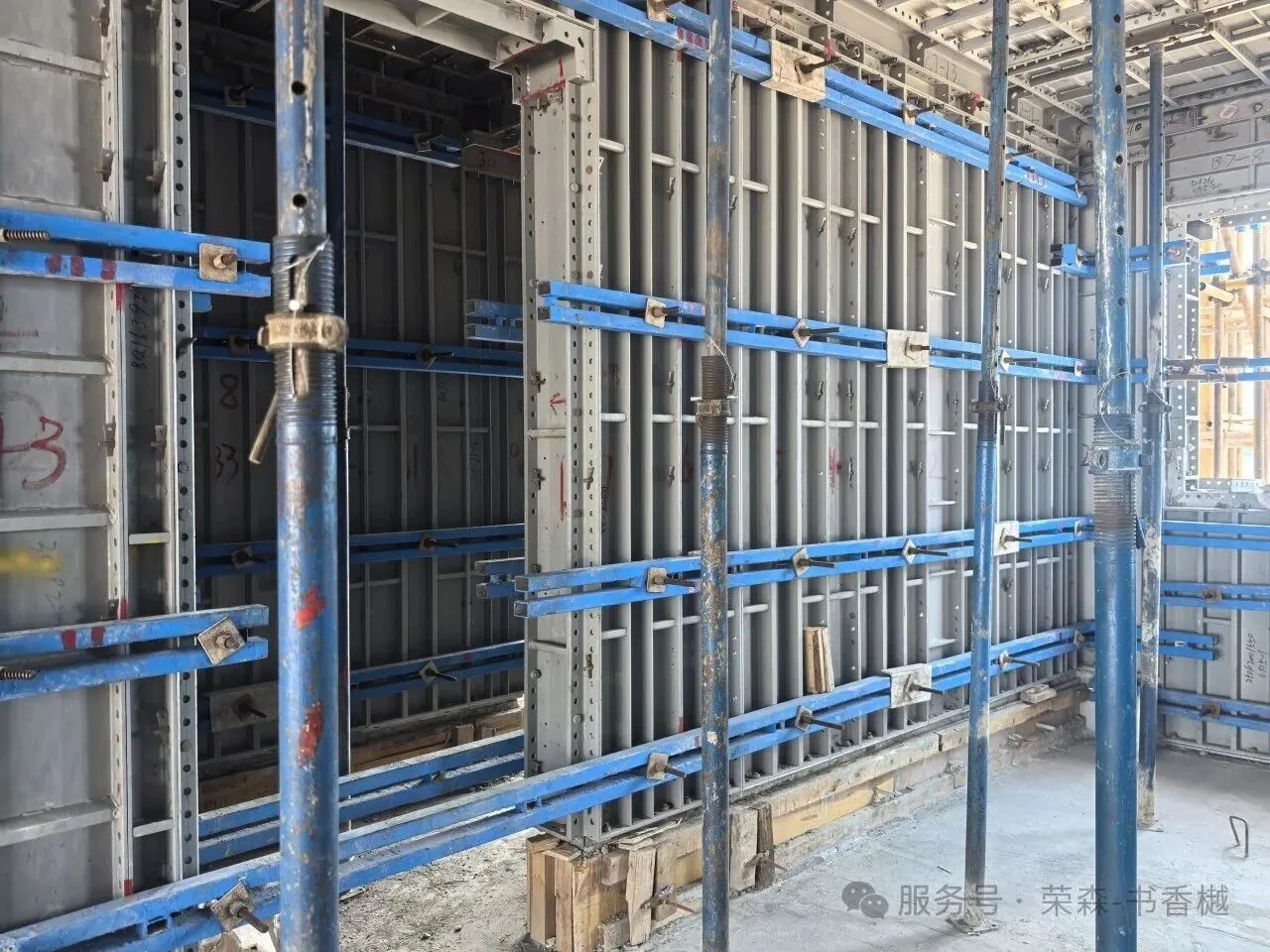


Why Insist on Using Aluminum Formwork?
01. Say Goodbye to "Patchwork Walls," Achieve Superior Quality from the Start. Traditional wooden formwork has many seams and poor rigidity, often resulting in uneven concrete walls and even problems like formwork bulging and grout leakage.
Aluminum formwork, on the other hand, boasts extremely high precision, with errors controlled within ±2mm, even reaching ±1mm. This means that the walls and floors of Rongsen Shuxiangyue, after demolding, have smooth and clean surfaces, essentially meeting the "fair-faced wall" standard. Extensive plastering and leveling are unnecessary, fundamentally reducing the risk of hollow areas and cracks caused by excessively thick plaster layers. For homeowners, this means receiving truly "natural" good walls upon moving in, slightly increasing usable room area and making later renovations easier.
02. Prevent Leaks, Build a Natural Waterproof Barrier. Leakage is the most troublesome common quality problem in housing.
In traditional wooden formwork construction, exterior walls, window sills, bathrooms, and kitchen waterproofing retaining walls often require secondary pouring, making the joints between new and old concrete prone to seepage. Rongsen Shuxiangyue utilizes aluminum formwork technology, enabling one-time casting of the structure. Whether it's kitchen chimneys, bathroom recessed retaining walls, or door and window lintels and small secondary components, everything can be completed simultaneously with the main structure. Especially for exterior walls, the entire structure is made of concrete, reducing cracks caused by the shrinkage of different materials and truly sealing off rainwater leakage paths at the source.
03 Living in "Greenery," Fulfilling Green Commitments with Aluminum Formwork Living in the city, being green and environmentally friendly is not just a sentiment, but also a matter of health. Traditional wooden formwork has a low turnover rate, consumes a lot of wood, and often results in construction sites piled with waste, creating a mess, dust, and noise pollution.
In contrast, the aluminum formwork system has extremely high recycling value and can be reused more than 300 times, generating almost no construction waste. Construction waste is significantly reduced, the site is clean and orderly, and pollution to the surrounding environment is minimized. This not only reflects the developer's social responsibility but also signifies an orderly construction environment, indirectly guaranteeing the stability of project quality.
04 More Efficient Construction, More Reliable Delivery Guarantee: Aluminum formwork utilizes an early-removal support system, making installation and dismantling simple and quick, increasing construction efficiency by approximately 40% compared to wooden formwork. Due to the stability of aluminum formwork, the concrete appearance after demolding is better, reducing waiting time for later repairs and allowing landscaping and interior decoration to begin earlier, achieving a streamlined "civil engineering-decoration" process.
05 The scarcity of aluminum formwork technology stems primarily from cost. The initial investment cost of aluminum formwork is 2-3 times that of traditional wooden formwork, and it requires extremely high stability of the drawings, allowing no arbitrary changes to the design later. This requires developers to accurately locate all design details (including water and electricity points, door and window openings) before construction begins, avoiding "three-sided projects" (designing, constructing, and modifying simultaneously).
Using aluminum formwork technology to create a smooth, leak-proof, durable, and environmentally friendly ideal home for every homeowner. This is not merely a choice of technology but a "quality-first" value system.