

The whole process of aluminum formwork installation
Aluminum formwork construction is popular mainly because the technical indicators are more advanced and can better meet the requirements of the country and society for construction projects.
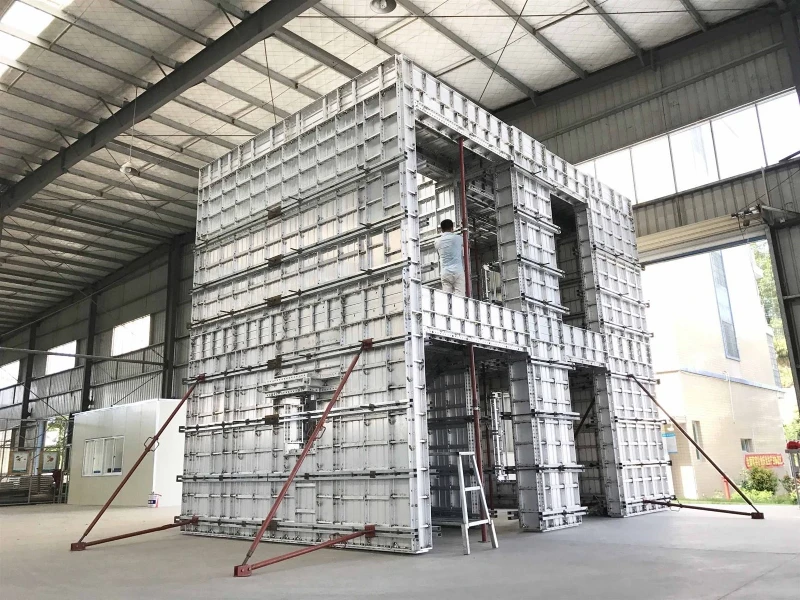
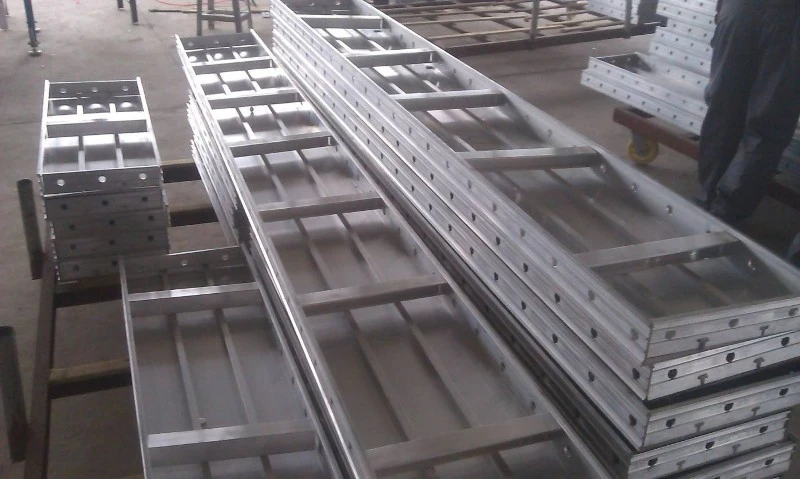
The whole process of aluminum formwork system construction preparation is as follows:
The design of architectural drawings and structural drawings is completed → the drawings are reviewed and quoted by aluminum formwork technicians → the content of cooperation is negotiated and the contract is signed → the technicians design the formwork drawings (formwork assembly drawings) → production according to the drawings → pre-assembly in the factory → qualified inspection → delivery and delivery → construction on the construction site.
Aluminum formwork construction process:
Wall formwork → beam formwork → staircase formwork → formwork acceptance → concrete pouring → quality acceptance → demolding (first installed and then demolded) → transported to the upper floor for construction.
Aluminum formwork assembly
1. Mark the wall column line and wall column control line and opening line on the floor. The wall column control line is 200mm away from the wall edge line to check whether the formwork is offset and square; mark the floor elevation control point on the column longitudinal reinforcement, and set it at the four corners and corners of the wall column to check the floor surface elevation.
2. Install the wall column reinforcement and embedded water and electricity boxes, wire pipes, reserved openings, etc., and complete the hidden project acceptance procedures after completion.
3. Install the wall column formwork
(1) When initially installing the formwork, fix the positioning bricks on the concrete surface with nails until the inside of the outer corner formwork to ensure that the formwork is installed in line with the layout line.
(2) All formwork is installed from the inner corner, so that the formwork remains lateral stable. A corner formwork can provide sufficient lateral support for a long wall formwork.
(3) Before installing the formwork, ensure that all contact surfaces and edges of the formwork have been cleaned and coated with release agent.
(4) When the corner is stable and the inner corner formwork is positioned according to the layout line, continue to install the entire wall formwork. For easy removal, the head of the pin should be as much as possible inside the inner corner formwork when the wall formwork is connected to the inner corner formwork.
(5) Before closing the formwork, a PVC tube must be pre-coated on the wall formwork connector. At the same time, the contact position between the sleeve and the wall formwork surface on both sides must be accurate so that the tension screws can be retracted after pouring.
(6) When the exterior wall deviates, it must be adjusted to the correct position as soon as possible. This only requires slightly tilting the exterior wall formwork in one plane. If there is a vertical deviation in two directions, more than two layers must be adjusted, one layer in each direction. Do not try to adjust the alignment of the formwork by lifting it on one side. If there is a large deviation, it is necessary to chisel part of the concrete to meet the requirements.
4. Install beam and top plate formwork
(1) Before installing the wall top side formwork and beam corner formwork, apply a release agent to the contact surface between the member and the concrete.
(2) When connecting the wall top side formwork and beam corner formwork to the wall formwork, pins should be inserted from the top to prevent the pins from falling off during pouring. After installing the wall top side formwork, you can start installing the plate formwork at the corner. Make sure that the contact edge has been coated with a release agent.
(3) The plate beam is used to support the plate formwork. In most cases, the plate beam should be assembled according to the plate formwork layout diagram. Use long pins and two ribs to connect the plate beam assembly to the two adjacent plate support beams.
(4) Install the tool column on the pre-installed beam assembly in the direction of the beam. This can protect its bottom when the tool column is removed.
(5) Use the tool column to lift the beam to the appropriate position. Connect the beam and plate formwork with pins through the end of the plate formwork installed at the corner.
(6) Ensure that the frame of the slab support beam has been coated with release agent before installation.
(7) The first formwork of each row has been connected to the wall top edge formwork and the support beam. The second formwork only needs to be connected to the first slab formwork. The second formwork is not connected to the beam in order to have enough adjustment range when placing the third formwork in the same row. After connecting the third formwork to the second formwork, fix the second formwork on the beam. Use the same method to place the remaining formworks in this row.
(8) Many rows of top slabs can be installed at the same time. Apply release agent on the top slab formwork surface before laying the steel bars.
(9) For beams and slabs with a span greater than 4m, the arch height of the formwork should be (1/1000-3/1000) of the component span. After the top slab is installed, the elevation of the entire formwork surface should be checked. If adjustment is required, a pad can be added to the bottom of the tool column to adjust the level. [2-6]
(10) Provide work benches for construction workers when installing floor slab formwork.
(11) For the aluminum alloy formwork quick-disassembly system, a material transfer port must be reserved on the top plate. The number, size and location of the material transfer port must be determined with the consent of the design unit, so that the formwork can be directly transferred to the upper layer through the material transfer port after the formwork is removed, thereby reducing the setting of the unloading platform and the use of tower cranes, ensuring the safety of the formwork transfer construction, and reducing the use of machinery.
5. Install the wooden outer starting board
(1) In places with continuous vertical formwork, such as elevator shafts, exterior walls, etc., use the wooden outer starting board to enclose the floor slab and serve as a connecting component for the vertical formwork of the upper layer.
(2) After the first layer is poured, the second layer will be connected to the K board as the starting point for the next layer of wall formwork
(3) The K board starting board is connected to the wall formwork. Before installing the K board, make sure that it has been cleaned and oiled. To prevent the pin from falling off during pouring, the pin must be inserted from the lower frame of the K board to the upper frame of the wall.
(4) A 16.5mm elliptical hole is opened on the outer edge of the K board. Before pouring, install the M16 bolts close to the bottom of the groove. These bolts will be anchored in the solidified concrete. After pouring, if necessary, the bolts can be adjusted to adjust the horizontality of the outer edge of the K board, which can also control the verticality of the formwork.
(5) Positioning of the K-board starting plate. Use a hanging line to check the positioning of the K-board outer starting plate: a straight K-board outer starting plate can ensure the straightness of the next layer of wall formwork.