

Overview of integral aluminum formwork process
In recent years, with the improvement of environmental awareness and the iteration of construction technology, the application of aluminum alloy formwork has been greatly improved. Compared with other types of formwork, aluminum formwork has the advantages of convenient construction, high construction efficiency and fast turnover speed. In addition, after years of development, the cost of aluminum formwork has been reduced, and the recycling rate is higher.
The overall aluminum alloy template system consists of: template system, support system, fastening system and accessories system.
(1)Template system Form the closed surface required for the construction of concrete structure to ensure the formation of the building structure during concrete pouring;
(2) Attachment system As the connecting component of the template, it makes a single template connected into a system and forms an integral whole;
(3) Support system In the process of concrete structure construction, it plays a supporting role to ensure the stability of floor, beam bottom and cantilever structure;
(4) Fastening system Ensure the structural width and size of the template forming, so that no deformation will occur during the concrete pouring process, and no expansion or explosion of the template will occur.
The advantages of the overall aluminum alloy template system are high concrete forming quality, multiple turnover times, shortened construction period, environmental protection and health, high recycling value, and efficient construction. It can be summarized as excellent quality, environmental protection and efficiency. Overall aluminum alloy template operation process
(1)Deepening design of aluminum alloy template;
(2)Aluminum mold production;
(3)Field trial and acceptance;
(4)On-site numbering, disassembly, packing and transportation site;
(5)On-site installation of aluminum mold;
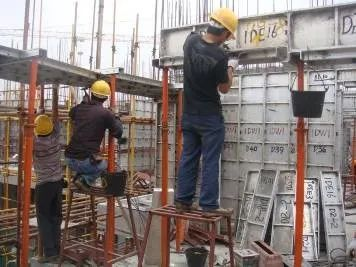
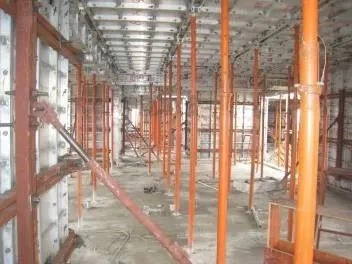
(6)Demolition of floor slab and beam bottom plate;
(7) Light sensing effect of concrete after demolition;


Detailed construction practices
Wall and column formwork assembly
(1) The wall column aluminum mold is composed of shaped wall panel mold (60*40 Angle aluminum at the bottom of the interior wall template and exterior wall inner mold, and K board at the top of the exterior wall outer side template), back beam, tie screw and diagonal support;
(2) The bottom corner aluminum is connected with the wall panel mold by bolt, and the wall panel mold is connected with each other and between the wall panel mold and K board by pin, with a pin spacing of 300mm;
(3) The back beam is set according to 4 inside and 5 outside. The first beam is 250 meters away from the ground, and the spacing between each beam is>700;
(4) The horizontal spacing of the pull screw is determined according to the aluminum mold design.

Scaffolding assembly of bay window panel
(1) The aluminum mold of the lower window panel is composed of plate mold, corner aluminum and back ridge;
(2) The lower window panel adopts the full enclosed assembly process, and a detachable vibration opening is reserved at the upper part. When pouring concrete, the formwork at the vibration opening is not installed first, and after the concrete is vibrated, the cover plate at the vibration opening is installed and the back ridge is strengthened;
(3) The plate mold and corner aluminum are connected by pins;
(4) Pin arrangement principle: pins should be set at the four corners of the plate mold, corner aluminum and both ends of the C groove, and the spacing between the pins in the middle should not be greater than 300mm.

Beam formwork assembly
(1) The beam mold is composed of fixed bottom mold, corner aluminum, fixed side mold and beam support. The beam support is set under the support rod, and the spacing between the support rods is less than or equal to 1200mm;
(2) The bottom mold, corner aluminum and side mold are fixedly connected by pins;
(3) Pin arrangement principle: the ends of the template (angle aluminum, C groove) should be set with pins, and the distance between the pins in the middle should not be greater than 300mm;
(4) The beam mold is connected to the shear wall mold through C groove.

Plate and template assembly
(1) The aluminum mold of the floor consists of the keel, plate support and plate mold. The support stand is set under the plate support;
(2) The keel, plate support and plate mold are fixedly connected by pins;
(3) Pin arrangement principle: the ends of the template (C groove) should be set with pins, and the distance between the pins in the middle should not be greater than 300mm;
(4) The slab formwork is connected to the shear wall formwork and beam formwork through C groove.

Formwork lifting and assembly
(1) For the construction of kitchen and bathroom suspension mold structure with a settlement of 20mm, aluminum mold is used together with reverse sill;
(2) The aluminum template is fixed with Angle steel.
C groove: mainly plays the role of bearing and transmission, its form is multiple, the use is wide, C groove pin hole distance is generally 100mm.
Corner aluminum: mainly serves as a connector, used for the connection of side plate bottom plate at the bottom corner of beam and shear wall at the top corner of wall panel. The pin hole distance of corner aluminum is 50mm.
K plate: There is no need to arrange K plate at the bottom of the first floor, but it needs to be set from the second layer using aluminum mold. K plate needs to connect the upper and lower exterior walls. K plate has been included in the main material cost of aluminum mold, and no separate cost is recorded.
