

Large Panel Formwork
Large panel formwork consists mainly of large pieces of metal formwork. It is most suitable for construction activities where formwork is highly repetitive as it can be reused many times. Therefore, its design is specified for the construction of the load bearing walls of typical floors in high rise tower blocks.
Compared with traditional timber formwork, metal panel formwork has several advantages. The use of large panel formwork can save time and labour in erecting, striking and re-erecting the formwork as the panel is handled as one unit. It can also produce a concrete surface, which is neater than is produced normally by conventional timber formwork, and the surface essentially needs no additional applied finishes for levelling. On site waste audit records also show large panel formwork systems are effective in reducing concrete waste generated by losses due to damaged formwork, which usually accounts for 30% of the total concrete waste. However, because of the weight of large panel formwork, tower cranes should be available for its handling.
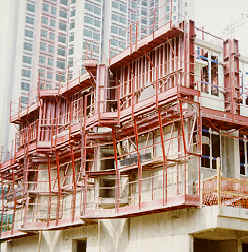
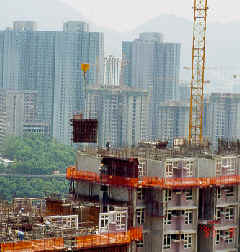
Different large panel formwork systems are widely used today by contractors for constructing standardised housing blocks, and are broadly classified as wall forms, table forms and tunnel forms.
Wall Forms
The wall forms are combined with the slab form so that the wall and slabs can be formed monolithically in one casting operation, and the number of joints between panels is minimised. There is less chance of grout leakage or an uneven surface finish at the joint, which is a common fault with in traditional timber formwork.
Table Forms
Standard modules of housing blocks are relatively large in span and large table forms are widely used for assembly time reduction, fewer joints and better surface finishes. The table method uses separate vertical forms for walls and horizontal table forms for floor slabs. The work is done in two stages. First, the walls are cast, and forms are stripped, the tables are then positioned, and the horizontal slabs are cast.
Tunnel Forms
The half tunnel is composed of vertical and horizontal panels set at right angles and supported by struts and props. The walls and slabs are cast in a single operation. Like the wall-forms and table forms, this reduces not only the number of joints, but also the assembly time. Therefore, the casting of walls and slabs can be completed in the one day.
Steel Forms
Because steel forms are very durable, one set of steel forms can be used to complete a project, and then reused for another project or scrapped for recycling. Steel forms can produce a better quality concrete finish when compared with timber forms. Although their initial cost is higher, they can be cheaper in the long run, particularly with their recycling potential.
Composite Steel Decking
Steel decking, becoming a permanent part of a composite slab, serves as both the working platform and formwork for supporting the in-situ slab concrete in the construction stage. The steel of the decking can also utilised to provide some of the required permanent reinforcement for the slab. In other words, the decking can replace both timber formwork and bottom reinforcement, reducing the amount of temporary works and formwork required.
Aluminum Forms
Aluminum formwork consists of small aluminum framed panels which are easy for handling. It is fast to erect and strike and the floor cycle can be 4 days. It is durable and can be reused over 100 times. Although it is more expensive than steel and timber, its merit is its lightweight and recycling potential.