

After nearly 20 years of operation and development, China tianqu group has become a large group enterprise integrating real estate, aluminum profiles, aluminum templates, doors and Windows, curtain walls, new energy, trade city, five-star hotels, etc., with more than 10 subsidiaries under its jurisdictionTianqu aluminum mold business covers aluminum mold research and development, design, production, sales, leasing, installation guidance and old plate renovation. At present, zaozhuang city in shandong province has a factory (covers an area of 150 mu, with an annual capacity of 300,000 square meters), zaozhuang city two factory (covers an area of 200 mu, with an annual capacity of 400,000 square meters), Qingdao factory (covers an area of 150 mu, with an annual capacity of 300,000 square meters, mainly radiation around Qingdao and overseas projects) three production bases.
Why Choose Us
High Quality Products
More than 90% of the global aluminum template enterprises are using 6061-t6 aluminum profiles, Tianqu aluminum mold is using self-developed high-strength aluminum alloy profiles.
Our Certificate
The enterprise has passed ISO9001 quality management system certification, the enterprise has been awarded AAA level credit certification, and has more than 40 patents, general manager Ni zuliang was awarded the "good faith entrepreneur" honorary title.
Our Service
Design technical support,Template pre-assembly support,TTechnical guidance and support,TMaterial supply support.
One-stop Solution
Tianqu aluminum mold business covers aluminum mold research and development, design, production, sales, leasing, installation guidance and old plate renovation.

The Aluminum Formwork Screw System
The Aluminum Formwork screw system is a more traditional way in the construction of aluminum mold. In this system, the screws are usually made of high-strength steel, and the aluminum forms are tightly held together by a threaded connection. The double pipe steel back is attached for reinforcement, and the overall stability is good. During the installation process

Aluminum Formwork Super High-Rise Screw System
Aluminum formwork super high-rise screw system is an advanced formwork support system widely used in the construction of super tall buildings. The system is mainly composed of a high-strength screw and a matching nut, a backing plate and other components. It has many significant advantages: in terms of structural stability, it can provide reliable support for the concrete pouring of super tall buildings, ensure the stability of the formwork system during the construction process

The Aluminum Formwork Pull System
The Aluminum Formwork pull system is a more advanced connection method. It is mainly composed of a pull piece and a connecting piece, and the adjacent aluminum template is fixed together through the pull knot action of the pull piece. Compared with the screw system, the installation and disassembly of the drawing system is faster and more convenient, which greatly improves the construction efficiency.

Aluminum For Molds can adapt to the construction needs of special shapes such as irregular and curved surfaces, offering greater design flexibility. This enables the creation of unique and innovative structures that may not be feasible with traditional templates. Aluminum For Molds meets the design requirements of various special structures of buildings, expanding the possibilities of architectural design.

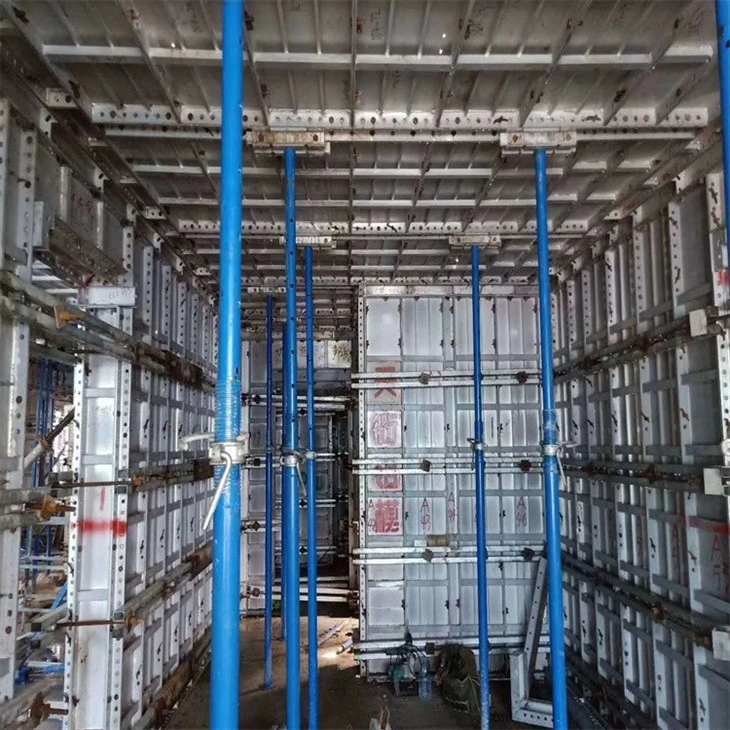
Wall Formwork is a crucial component within the aluminum formwork system, specifically designed for concrete wall pouring construction, ensuring the geometric shape, dimensional accuracy, and surface smoothness of the walls. Below is a detailed introduction to wall formwork:

The demountable aluminum formwork system, leveraging its modular, standardized, and easily disassemblable attributes, not only substantially enhances efficiency and convenience in building construction but also demonstrates significant specialized advantages in design optimization, quality control, cost management, safety, and environmental protection. It powerfully drives the industrialization, refinement, and greening of the construction sector.

Lower Cost High Efficiency Aluminium Formwork
The production according to a unified standard ensures consistent quality and performance across multiple templates. The increased interchangeability and universality of Lower Cost High Efficiency Aluminium Formwork allow for easier integration into different projects. This standardization leads to greater efficiency in the production process and easier quality control.

Wall Slab Column Formwork System
Wall Slab Column Formwork System constitutes a pivotal constituent within the aluminum formwork system, tailored explicitly for the construction of concrete walls, guaranteeing their geometric integrity, dimensional precision, and surface evenness.

Aluminium stair formwork refer to the precast formwork system made of aluminum alloy materials to pour concrete stairs in building construction. This construction method has the characteristics of high efficiency, accuracy, environmental protection and reusable, especially suitable for high-rise residential buildings, commercial buildings and other projects with high construction speed and engineering quality requirements.
What is Standard Aluminum Formwork
Standard Aluminum Formwork use self-developed high-strength aluminum alloy profiles: more than 90% of the global aluminum template enterprises are using 6061-t6 aluminum profiles, Standard Aluminum Formwork is using self-developed high-strength aluminum alloy profiles, Webster's hardness up to 17HW, the number of times of use and template performance is far greater than peers.
Benefits of Standard Aluminum Formwork
The short phase of construction
The aluminium formwork is in accordance with the fast dismantlement formwork system. It is more reasonable to save your management expenditure in that one coating (a panel of wooden board and 4–6 sets of prop systems) can be done in five functional days so the building work can be led in a swift manner.
User-friendly and great in efficiency
The aluminium formwork system is simple to assemble with the normal weight of 20kg, which can be totally removed and summative by hand. When you buy aluminium formwork from any of the manufacturer or supplier in Pune, the humble design of it makes it hassle-free for the workforces to learn and accelerate the work flow; its average operational rate per worker is 20–30 sq.m.
Robust steadiness and load capacity
Currently, most of the aluminium formworks have the load capacity of 60KN/square meter, which is adequate to fulfil the loading capacity requisite of the branch formwork in most of the uptown buildings.
Extensive range of applications
The aluminium formwork is appropriate for the wall, the horizontal floor block, the post, the beam, the stairway, the window, as well as the moving plate, etc. Aluminium formwork is also helpful in secondary constructions such as the bond beams as well as ties columns.
High reuse rate, lowering the average cost
A broad set of the aluminium formwork system, whose original material is trodden as a cohesive system, can be utilized repetitively for beyond 300 times, i.e., 5RMB per sq. m.
Lesser joints fissure and enhanced accuracy
You will find a smoother surface of the concrete after removal. There is no requirement to plaster the concrete after the withdrawal of the aluminium formwork.
Traditional Aluminium Formwork
Traditional aluminium formwork is the most commonly used type and serves as the foundation for other variations. It comprises robust aluminium frames and panels that are interconnected to create temporary molds for concrete placement. This type of formwork is highly adaptable and can be customized to accommodate various structural designs and dimensions. Traditional aluminium formwork offers excellent reusability, making it a cost-effective choice for projects with repetitive construction requirements.
Engineered Aluminium Formwork
Engineered aluminium formwork takes the concept of traditional formwork a step further by incorporating precision engineering and advanced design techniques. It consists of prefabricated panels, beams, and props that are manufactured with utmost accuracy to ensure seamless assembly and superior structural integrity. Engineered aluminium formwork provides exceptional dimensional accuracy and consistency, resulting in high-quality concrete finishes. This type of formwork is suitable for complex construction projects that demand precise specifications and tight tolerances.
Modular Aluminium Formwork
Modular aluminium formwork is a versatile and time-saving option that offers a systematic approach to construction. It consists of standardized panels, frames, and accessories that can be easily assembled and disassembled. The modular design allows for quick formwork installation, enabling faster construction progress. Additionally, the uniformity of the system ensures consistency in the structural elements and concrete finishes. Modular aluminium formwork is suitable for projects with repetitive layouts, such as residential buildings, where speed and efficiency are of utmost importance.
Climbing Aluminium Formwork
Climbing aluminium formwork is specifically designed for tall structures and vertical construction projects. It allows for the incremental construction of high-rise buildings without the need for external scaffolding. The formwork system is mounted on climbing brackets, which are hydraulically or mechanically lifted as the construction progresses. This method offers significant time and cost savings by eliminating the need for external support structures and reducing labor requirements. Climbing aluminium formwork ensures the smooth and efficient construction of vertical elements, such as walls and cores, in tall buildings.
Hotels
Aluminium formwork systems are widely used in hotel constructions with typical floors. An aluminium formwork system accelerates schedules through its capabilities for the pre-integration of formwork into modular elements assembled like interlocking building bricks. The formwork can also be reused across multiple floors to reduce costs. Vermare Hotel in Uvero Alto is a key project example.
Teaching Buildings
Teaching buildings comprise typical floors and unified classrooms and offices. Reusable aluminium formwork systems facilitate the rapid construction of such structures while still offering high precision and flexibility with uniform layouts and consistent finishes. The system helps prestigious teaching buildings complete the development of their new campus. Customizable aluminium formwork solutions are ideal for such projects.
Bridges
Mass concreting coupled with heavy scaffolding erection/dismantling are challenges. A light yet robust aluminium formwork system optimizes this through customizable modular systems reconfigured efficientl
Pipe Galleries
Subterranean concrete networks involve sizable 3D forming efforts and accelerated stripping cycles. A durable yet lightweight modular aluminium formwork solution eases this through single-sided systems integrating formwork, rebar cages, and feed boxes.
Tunnels
Underground forming within constrained access and surrounding soil/water stresses conventional systems. Aluminium formwork systems offer an economical, fast, and reliable solution. They allow rapid finishes without compromising on quality. Customized formworks from reputed providers excel in this regard.
Railways
Aluminium formwork systems play a key role in the construction of railway stations. From platforms and concourses to ticketing areas and underground passages, these systems enable streamlined workflows and consistent quality. The modular design of these formwork systems allows for quick assembly and disassembly. This is exemplified in the Taiwan Sanying MRT Station and Asian high-speed rail terminus.
Components of Standard Aluminum Formwork
Panels
The panels are the main structural element of the system. They are the largest and most important component of the formwork. They are made up of sheets of aluminium that are held together by braces. The panels are what give the structure its shape and strength. They have interlocking features, so they can be quickly assembled and disassembled without the need for tools.
Connectors
The connectors are used to join the panels together. They are made of aluminium and are easy to use. They can be quickly connected and disconnected without the need for any extra tools. The clamps are used to hold the panels together while the concrete is being poured. They are attached to the panels with bolts to fasten the panels properly.
Bracing
The braces are used to connect the panels together. They are made of aluminium and are bolted or welded to the panels. Aluminium braces are mainly used for supporting roofs, beams, columns, and other parts of buildings.Apart from these, the aluminium formwork is divided into other 3 components- slab components, wall components & beam components.
How to Choose Standard Aluminum Formwork
Understand the needs
Before buying an aluminum alloy formwork, you need to clearly understand your needs, including the type of construction project, structural form, construction requirements, etc. Different project requirements require different types of aluminum alloy formwork, so you need to choose according to actual needs.
Choose the right specifications and materials
The specifications and materials of the aluminum alloy formwork are important factors affecting its quality and price. When choosing, you need to consider the following aspects: Choose the right specifications and sizes according to the needs of the construction project. Generally speaking, the more complex the specifications of the aluminum alloy formwork, the higher the price. The materials of the aluminum alloy formwork mainly include 1100, 3003, 5005 and other models. Different models of aluminum alloy have different strengths and toughness, and need to be selected according to actual needs.
Pay attention to processing technology and surface treatment
The processing technology and surface treatment of the aluminum alloy formwork are also important factors affecting its quality and price. When choosing, you need to pay attention to the following aspects: Processing technology: The processing technology of the aluminum alloy formwork includes cutting, stamping, drilling and other links, and you need to pay attention to the processing accuracy and process level. Surface treatment: The surface treatment of the aluminum alloy formwork mainly includes spraying, oxidation, electrophoresis and other processes, and you need to pay attention to the quality and effect of the surface treatment.
Consider cost performance
The price of aluminum alloy formwork varies depending on factors such as brand, quality, and specifications. When purchasing, you need to consider cost performance based on actual needs and budget, and choose an aluminum alloy formwork that is reasonably priced and meets project requirements.
Aluminum formwork acceptance criteria
Elevation requirement
Check the steel reinforcement of aluminium formwork building for any misalignment and notify relevant personnel to make necessary adjustments. Measure the ground height based on the control line, and if any deviations are observed, inform the general contractor and coordinate with workers for corrective measures.
Aluminium formwork positioning bars welding
For welding of reinforcement bars about positioning, it is recommended to use φ10 or φ12 steel bars. Weld the steel bar at the root of the wall column about 80mm from the ground, and the spacing between them should not exceed 700mm. Additionally, the end of the wall or column should be sealed with a well-tac-toe welding technique.
Aluminium wall formwork push pull prop requirements
The hole depth should be 50mm and the distance to the wall should be 450mm. The spacing between push pull prop should meet the requirement of no more than 1000mm.
Requirements for kicker in aluminium formwork
After dismantling the kicker in aluminium formwork, it must be cleaned thoroughly. The kicker in aluminium formwork on the external wall shall be set with pins and wedges at intervals of 200mm.
Requirements for aluminium formwork wedge pin
For aluminium wall formwork with a structural elevation below 1.5 meters, the spacing between pins and wedges should be 200mm. For aluminium wall formwork with a structural elevation above 1.5 meters, the spacing between pins and wedges should be 300mm. Additionally, the long edge of the aluminium formwork floor slab must have no fewer than 3 holes for positioning.
Wire rope requirement
The wire rope should be arranged with a spacing of no more than 1200mm. Two wire ropes should be installed for outer aluminium wall formwork longer than 2m, and one wire rope should be installed for those shorter than 2m. The connection point of the wire rope should be 2000mm above the aluminium wall formwork.
What Should Be Paid Attention To During The Construction Of Building Aluminum Formwork?
Note1: The construction of aluminum formwork can add more integrally formed concrete components to the exterior walls and interiors, resulting in greater changes in the rigidity of the building structure. Therefore, the influence of these added concrete components should be fully considered in the structural design, and the increased rigidity of the external wall can be used, and the increased indoor load should also be included to make the force more reasonable.
Note 2: The wall surface of the construction aluminum formwork is too smooth, which will easily cause the hidden danger of the internal and external wall tiling and the insulation layer. Therefore, during the construction, attention should be paid to in-depth research on the release agent and wall tile adhesive. Particularly, the walls with internal and external thermal insulation need to be prepared for local swaying and anti-falling measures.
Note 3: The change in the section of the upper shear wall of the building exposes the disadvantage of insufficient flexibility of the architectural aluminum formwork. Therefore, in the design of the architectural aluminum formwork, the matching of standard parts and non-standard parts should be more rationally optimized. On the other hand, It is also necessary to improve the standardization of the main design to improve construction efficiency.
Key Market Drivers for Standard Aluminum Formwork
Urbanization Infrastructure Development
Rapid urbanization across the globe is driving the need for efficient building solutions, including aluminum formwork systems. As cities continue to expand to accommodate growing populations, the need for high-quality, sustainable, and aesthetically pleasing buildings is increasing. Aluminum formwork systems offer a lightweight yet strong solution for constructing modern buildings and infrastructure. Their adaptability to a variety of building designs, coupled with their durability and corrosion resistance, make them a top choice for urban development projects.
Sustainability and Green Building Practices
The global emphasis on sustainability and eco-friendly building practices has driven the adoption of aluminum formwork systems. These systems are well aligned with green building standards due to aluminum's recyclability, energy efficiency, and minimal environmental impact. Architects and developers are increasingly incorporating aluminum formwork systems into their projects to meet stringent energy efficiency requirements and reduce the carbon footprint of buildings. Aluminum's lightweight properties also help reduce transportation costs and energy consumption during construction, further strengthening its role in sustainable development.
Technological Advancements in Design and Manufacturing
Technological advancements such as advanced design software, 3D modeling, and computer-aided manufacturing (CAM) are driving innovation in the aluminum formwork systems market. These tools enable architects and engineers to create complex designs, optimize structural performance and increase efficiency. Digitalization also facilitates collaboration among stakeholders by enabling real-time sharing of design data and project information. Automated manufacturing processes increase precision, reduce errors and speed up production, ensuring that aluminum formwork systems meet the needs of modern construction timelines.
Architectural Flexibility and Aesthetic Appeal
Aluminum formwork systems offer unparalleled architectural flexibility, allowing designers to realize their creative visions without compromising structural integrity. The material's malleability and compatibility with a variety of finishes enable the creation of unique facades, complex geometries and innovative interior spaces. Architects value aluminum's ability to create sleek, modern designs, making it a popular choice for commercial, residential and institutional projects. The aesthetic versatility of aluminum formwork systems caters to changing architectural trends and consumer preferences.
Lightweight Structures and Reduced Foundation Requirements
In a field of construction characterized by speed and efficiency, aluminum formwork systems offer significant advantages: heavy to light. Aluminum's high strength-to-weight ratio makes it possible to build strong structures with reduced material consumption. This not only helps save costs, but also minimizes loads on foundations and supporting structures. The lightweight nature of aluminium formwork systems is particularly beneficial in earthquake-prone areas where buildings need to withstand ground movements while remaining structurally stable.

Our Factory
After nearly 20 years of operation and development, China tianqu group has become a large group enterprise integrating real estate, aluminum profiles, aluminum templates, doors and Windows, curtain walls, new energy, trade city, five-star hotels, etc., with more than 10 subsidiaries under its jurisdictionTianqu aluminum mold business covers aluminum mold research and development, design, production, sales, leasing, installation guidance and old plate renovation. At present, zaozhuang city in shandong province has a factory (covers an area of 150 mu, with an annual capacity of 300,000 square meters), zaozhuang city two factory (covers an area of 200 mu, with an annual capacity of 400,000 square meters), Qingdao factory (covers an area of 150 mu, with an annual capacity of 300,000 square meters, mainly radiation around Qingdao and overseas projects) three production bases.
certificate

FAQ
Hot Tags: standard aluminum formwork, China standard aluminum formwork manufacturers, suppliers, factory


